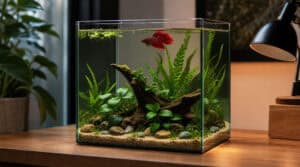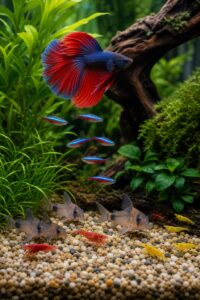

A standard 10-gallon aquarium is arguably the perfect canvas for a betta fish. It provides enough water volume to keep your nitrogen cycle stable, but it is compact enough to fit on a sturdy desk or bedroom stand.
Before you start buying plants and hardscape, remember that every successful 10-gallon betta tank relies on the same baseline gear. You need a reliable 50-watt adjustable heater to maintain that crucial 78°F to 80°F temperature range, and a gentle filtration system. A basic sponge filter driven by a small air pump, or a hang-on-back (HOB) filter with a baffled output, will keep the water clean without blowing your betta around the tank.
Once your hardware is sorted, you can focus on the layout. Here are 12 aquascape setups you can realistically recreate in a 10-gallon tank without overbuying or overcomplicating your maintenance routine.
| Setup Name | Difficulty Level | Lighting Need | Primary Substrate |
|---|---|---|---|
| 1. Cryptocoryne Jungle | Beginner | Low | Sand or Fine Gravel |
| 2. Driftwood Island | Beginner | Low to Medium | Sand |
| 3. Blackwater Biotope | Beginner | Very Low | Sand + Leaf Litter |
| 4. Beginner Iwagumi | Intermediate | Medium to High | Aquasoil |
| 5. Floating Plant Canopy | Beginner | Medium | Gravel |
| 6. Minimalist River Stone | Beginner | Low | Sand |
| 7. Moss Tree Aquascape | Intermediate | Medium | Aquasoil or Sand |
| 8. Dual-Corner Triangle | Beginner | Medium | Gravel or Aquasoil |
| 9. Dutch-Style Stem Garden | Advanced | High | Aquasoil |
| 10. Dragon Stone Cave | Intermediate | Medium | Aquasoil (Back) / Sand (Front) |
| 11. Emergent Riparium | Intermediate | Medium | Gravel |
| 12. Dirted Walstad Method | Advanced | Medium | Potting Soil capped with Sand |
1. The Low-Light Cryptocoryne Jungle
If you want a lush, green tank without upgrading to an expensive high-output LED light, a Cryptocoryne (Crypt) jungle is the way to go. Crypts are heavy root feeders, so you will need a substrate of fine gravel or sand supplemented with root tabs.
Plant several varieties, like Cryptocoryne wendtii and Cryptocoryne lutea, densely across the bottom. They may “melt” (lose their leaves) when first introduced to your water parameters, but leave the roots alone. They will bounce back. The broad, soft leaves are incredibly safe for betta fins, and the dense growth provides excellent hiding spots.
2. The Driftwood Island Centerpiece
This layout focuses the visual weight right in the middle of the 10-gallon tank. You will need a single, striking piece of spider wood or mopani wood. Place it in the center on a bed of light-colored pool filter sand.
Instead of planting in the substrate, you will use cyanoacrylate super glue (gel control) to attach epiphytes directly to the wood. Anubias nana and Java Fern are perfect for this. Because the plants are attached to the wood, you can easily lift the entire centerpiece out of the tank if you ever need to do a deep clean of the sand.
3. The Blackwater Botanical Biotope
A blackwater setup mimics the natural, tannin-stained waters of a betta’s wild habitat. The gear requirement here is minimal: a basic sponge filter is ideal because it won’t suck up the decaying organic matter.
Use a thin layer of sand and scatter Indian almond leaves, alder cones, and small twigs across the bottom. As these botanicals break down, they release tannins that turn the water a tea-like brown color. This lowers the pH slightly and has natural antibacterial properties that are excellent for a betta’s slime coat and fin health. You only need a very low-output light for this setup.

Tender Tropicals Premium Catappa Leaves for Shrimp Tanks
Check Price4. The Beginner-Friendly Iwagumi Layout
Traditional Iwagumi layouts are high-tech, requiring intense lighting and CO2 injection to carpet the floor. You can do a low-tech version in a 10-gallon tank by making smart gear choices.
Use an active aquasoil to provide plenty of nutrients. Instead of demanding carpeting plants like Dwarf Baby Tears, use Dwarf Hairgrass or Pearl Weed. For the stone hardscape, avoid Seiryu stone if you struggle with high pH, as it can alter water chemistry. Opt for inert stones like smooth slate or river rock. Arrange an odd number of stones (usually three or five) with one dominant “father” stone slightly off-center.
5. The Floating Plant Canopy
Bettas love hanging out near the surface, and a floating plant canopy caters directly to that behavior. For this setup, the substrate and lower plants matter less than the surface.
You will need plants like Red Root Floaters, Water Lettuce, or Salvinia. Crucial gear note: Floating plants will rot and die if their tops get wet from heavy surface agitation. You must use a baffled HOB filter or a sponge filter turned down low to keep the water surface relatively still. The roots will dangle down into the water column, absorbing nitrates and giving your betta a jungle gym to swim through.
6. The Minimalist River Stone Bed
If you hate trimming plants and vacuuming around complicated driftwood, the minimalist river stone bed is highly practical. You need a bag of smooth, round river stones in varying sizes (from golf ball to baseball size) and a bag of standard aquarium sand.
Bank the sand slightly higher in the back of the tank and scatter the stones naturally. Add a few tall, easy background plants like Vallisneria to hide your heater and filter tube. Because the stones are completely smooth, there is zero risk of your betta tearing its fins, and you can easily push a gravel vacuum into the sand during weekly maintenance.
7. The Moss Tree Aquascape
This setup uses a specialized piece of hardscape—a bonsai driftwood tree—to create the illusion of a miniature landscape.
You will need to glue clumps of Java Moss, Christmas Moss, or Weeping Moss to the branches of the driftwood. Plant a short, grassy plant around the base to act as the “lawn.” Moss acts as a magnet for detritus, so you need a filter that provides good mechanical filtration without creating a whirlpool. A small internal power filter with an adjustable flow rate works well here.

Azil Bonsai Driftwood Aquarium Tree
Check Price8. The Dual-Corner Triangle Layout
In a 10-gallon tank, equipment can easily become an eyesore. The dual-corner layout solves this by banking aquasoil heavily in the back left and back right corners, leaving a V-shaped valley of plain sand in the front middle.
Plant tall, dense stem plants (like Bacopa caroliniana or Water Wisteria) in the two back corners. You can hide your 50W heater in one corner and your filter intake in the other. The plants will eventually obscure the gear, while the open sand valley in the middle gives your betta plenty of unobstructed swimming space.
9. The Dutch-Style Stem Garden
A Dutch-style tank relies entirely on the contrast of plant colors, leaf shapes, and textures, using absolutely no driftwood or rock hardscape.
You will need a nutrient-rich aquasoil and a medium-to-high output LED light. Group stem plants tightly together in distinct “streets” or rows. You might use bright green Rotala rotundifolia next to reddish Ludwigia repens. This setup requires the most maintenance on this list. You will need a good pair of aquascaping scissors, as you will be trimming the stems weekly to keep the bushes dense and shaped.
10. The Dragon Stone Cave System
Ohko stone, commonly known as Dragon Stone, features incredible craters and textures that look stunning in a 10-gallon tank. You can stack these stones to create caves and swim-throughs for your betta.
Bank aquasoil in the back to support the heavy stones, and use a cosmetic sand in the front. Plant small Anubias in the crevices of the stone to soften the look.
11. The Emergent Riparium Setup
A riparium involves filling the 10-gallon tank only 60% to 70% full and allowing plants to grow up and out of the water.
You can use a standard HOB filter for this. Place the roots of houseplants like Pothos, Peace Lilies, or Lucky Bamboo directly into the filter basket or secure them to the back glass using suction cups. The roots will grow down into the water, pulling out massive amounts of nitrates, while the foliage grows above the rim. The water dropping from the filter creates a pleasant waterfall effect, though you may need to place a sponge under the output if the current is too strong for your betta.
12. The Dirted Walstad Method Tank
Popularized by Diana Walstad, this method relies on a heavily planted environment to do the heavy lifting for filtration.
You will need organic, additive-free potting soil. Lay down one inch of soil, and then strictly cap it with 1.5 inches of sand or fine gravel so the dirt doesn’t muddy the water. You must plant the tank incredibly densely from day one—use fast-growing stem plants and floaters. The gear is minimal: just your heater and a small sponge filter or powerhead simply to keep the water circulating. The plants and the soil bacteria handle the biological filtration.
Whichever layout you choose, remember that the gear and the hardscape are only the beginning. Always fully cycle your 10-gallon tank—testing for ammonia, nitrite, and nitrate—before introducing your betta. Pair your new aquascape with a consistent routine of 20% to 25% weekly water changes, and your setup will thrive for years.